AI Practitioner · Builder · Researcher

Sunil
Sivadas
Ph.D.

AI Practitioner  ·  Builder  ·  Distinguished Engineer

Building agentic AI systems, creating IP, and turning frontier research into working technology, from conversational AI to multi-agent architectures.

Scroll
Sunil Sivadas, Ph.D.
About

Practitioner.
Educator.
Builder.

I build zero-to-one teams: small groups that take an idea from first principles to a product running in production. The work starts before any prototype exists, with technology validation and market readiness assessment of whether a capability actually works and whether clients will adopt it.

That discipline has produced Ins8.ai, the speech-to-text platform tuned for Singlish and ASEAN accents, now NCS's Conversational AI line; NEXTgpt, our generative AI prototyping sandbox, presented to 70+ C-suite clients; Sunshine.agent for enterprise agentic AI; Sunshine.guardian, our AI safety testing product; and SOLARIS, an agentic AI system built with the Land Transport Authority. Three consecutive NCS Heroes Gold Awards.

Today I direct AI innovation at NCS as Principal AI Architect, AI Safety, with a remit across AI safety, agentic AI and conversational AI. I lead independent assurance engagements under IMDA's AI Verify Foundation Global AI Assurance Sandbox, developing reusable testing methods others can apply, and represent NCS in the MERaLiON consortium, shaping how Singapore's national multimodal speech LLM is evaluated and adopted by enterprises.

Before NCS, I spent six years at A*STAR's Institute for Infocomm Research as Unit Head for Human Language Technology, leading conversational AI research and serving as Principal Investigator on national deployments: real-time transcription for the Singapore State Courts, and speech recognition for air traffic management with the Civil Aviation Authority of Singapore. Before that, eight years as a Senior Researcher at Nokia Research Center (Bell Labs) in Finland, building noise-robust, small-footprint speech recognition for mobile devices and physiological computing systems, and representing Nokia in the EU's TC-STAR speech-to-speech translation programme.

25+ years in AI. PhD in Electrical Engineering, seven granted US patents, 1,800+ citations. NCS Distinguished Engineer. Former Adjunct Associate Professor at NTU's College of Computing and Data Science. Author of The Agentic AI Builder's Handbook.

Full Profile ↗
25+
Years in AI/ML
7
Granted Patents
1,804
Scholar Citations
70+
C-Suite Demos Led
S$42.4M
SCALE Lab Directed
3×
NCS Heroes Gold
Published Work

The Agentic AI
Builder's Handbook

A practitioner's guide to building systems that go beyond demos and prototypes, addressing why enterprise AI has a high degree of complexity, what it actually takes to deploy agents in production, and how AI capability is reshaping real economic value.

Why Agentic? Capability, economic signals & the production gap
METR Time Horizons: What autonomy benchmarks actually measure
GDPval: AI on economically meaningful tasks across 44 occupations
The Jagged Frontier: Where AI surprises and where it fails
Building for Adoption: From PoC to production-grade deployment
Read Online · Free ↗
The Agentic AI Builder's Handbook
Sunil Sivadas, Ph.D.
Writing & Talks

Ideas I'm working on.

Self-Improving Systems
answers change
study method change
exam fixed
= self-improvement, not recursion

What has to be true before a system can safely improve itself?

Think of a self-improving AI as a student. Three things can change: the answers, the way of studying, and the exam. Almost everything shipping in 2026 is the student studying smarter against an exam someone else wrote. The classrooms it learns in are often bad, and under pressure the student learns the teacher instead of the subject. A test case from our own harness shows why locking the exam away is not enough: the mark has to come from the fact, not from the student's account of it.

A self-improving system is only ever as safe as the exam it cannot game. Verification first, autonomy second.

Read the article ↗
Realized Value Series
capability
× cost
× reliability
× safety
× controllability
= realized value

Realized Value: A Framework for Evaluating Agentic AI in the Enterprise

Frontier capability is growing fast. Yet most enterprises still struggle to put agentic AI into production. GDPval shows models matching or beating experts on 84.9% of deliverables. METR puts the realised gain with a human in the loop at 1.4–2×. The Remote Labor Index finds end-to-end autonomous completion at 21.25%. Three true numbers. One gap. This series is about what sits between them.

realized value = capability × cost × reliability × safety × controllability. The factors multiply, so one near-zero factor zeros the product.

Read the series ↗ Part 1: Capability ↗ Part 2: Cost ↗ Part 3: Reliability ↗ Part 4: Safety ↗ Part 5: Controllability ↗
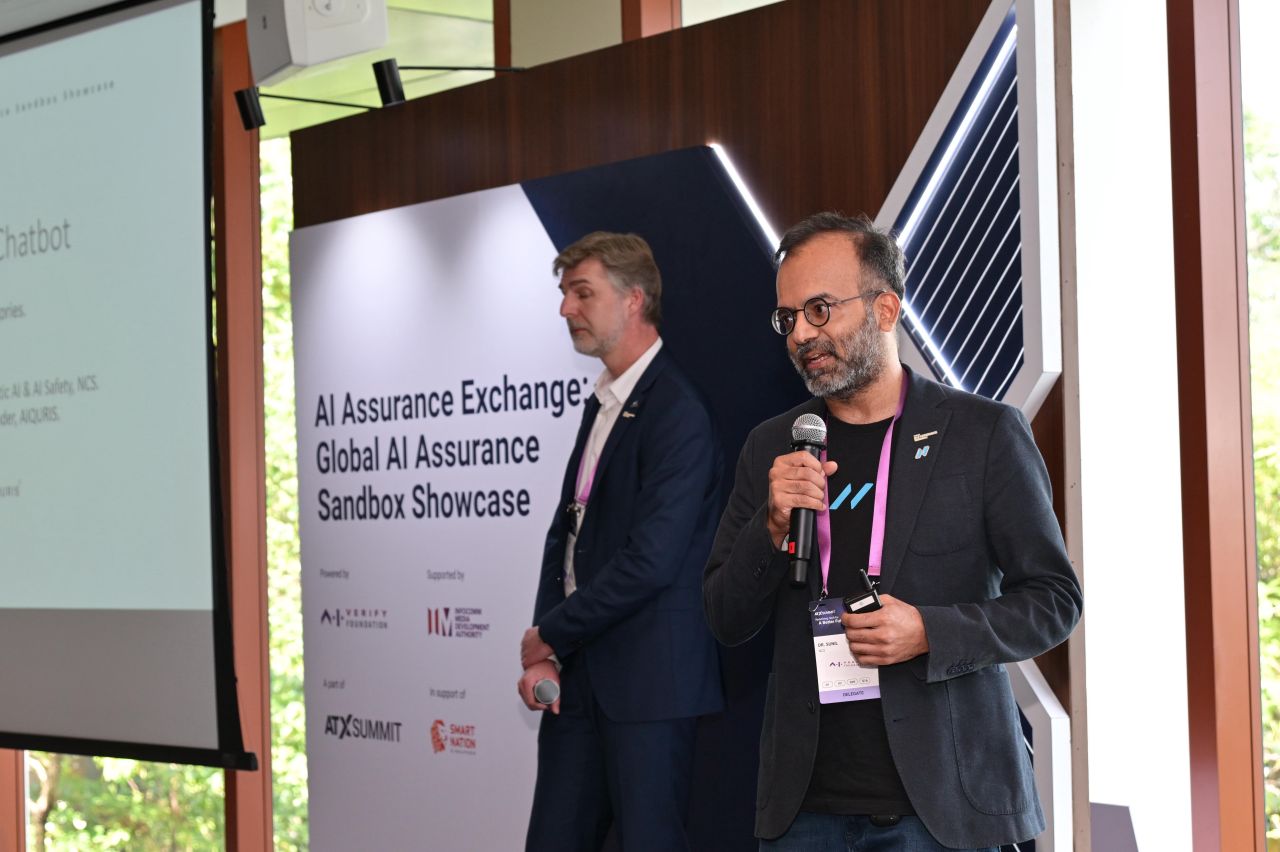
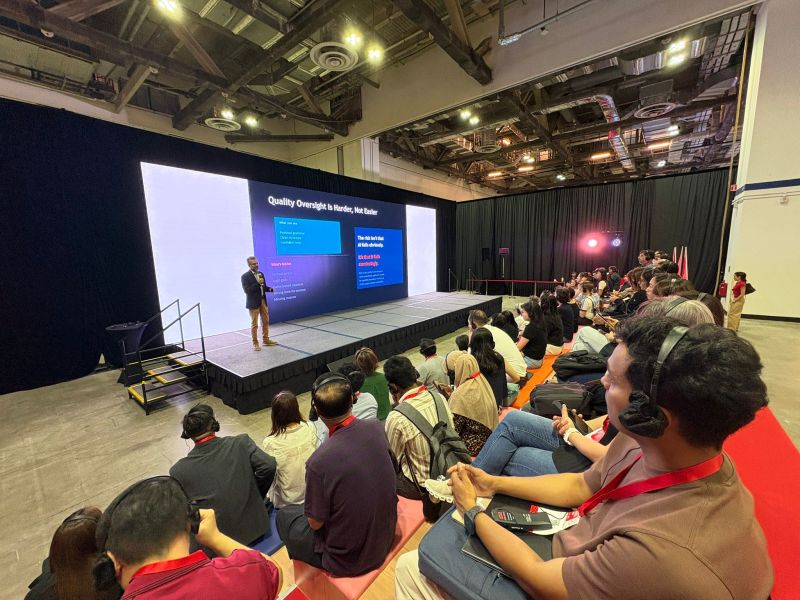
Sunil Sivadas speaking at the AI Assurance Exchange: Global AI Assurance Sandbox Showcase at ATxSummit

Testing makes the invisible visible

At the IMDA AIVF AI Assurance Sandbox Showcase at ATxSummit, Dr Martin Saerbeck and I shared our case study on building a reusable assurance framework around a live AI career guidance chatbot, one that serves graduates, career switchers, and retrenched workers across Singapore. Our approach began with the people the system serves and the harms they face: tone with vulnerable users, safeguards for minors, parity across gender and age.

Wan Sie Lee, Executive Director of the AI Verify Foundation, framed the whole conversation in one line. Prof. Russell added the horizon: as systems approach superhuman levels, real-world testing reaches its limit. Mathematical, analytical guarantees will be needed. The systems deployed today are a different case, they already shape real decisions. Careers. Money. Health.

Testing makes the invisible visible. For the systems shaping real decisions today, that is how we earn trust.

Read on LinkedIn ↗
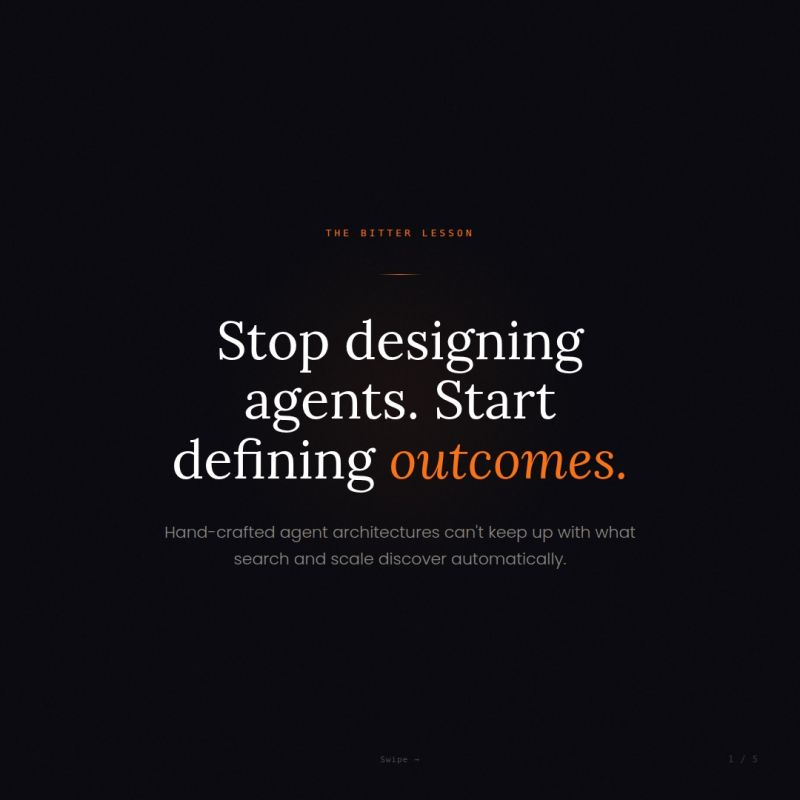
Stop designing agents. Start defining outcomes.

The Bitter Lesson is about to hit agentic AI builders

Hand-crafting agent architectures, stitching system prompts, tool definitions, routing logic, guardrails, is the same pattern the bitter lesson has punished every time. A new open-source framework from UC Berkeley (optimize_anything / GEPA) treats any text artifact as an optimizable parameter. A 10-line agent stub automatically evolved into a 300+ line multi-stage system. ARC-AGI accuracy went from 32.5% to 89.5%. No human designed that architecture.

The craft of building AI applications is shifting, from designing agents to defining outcomes.

Read on LinkedIn ↗
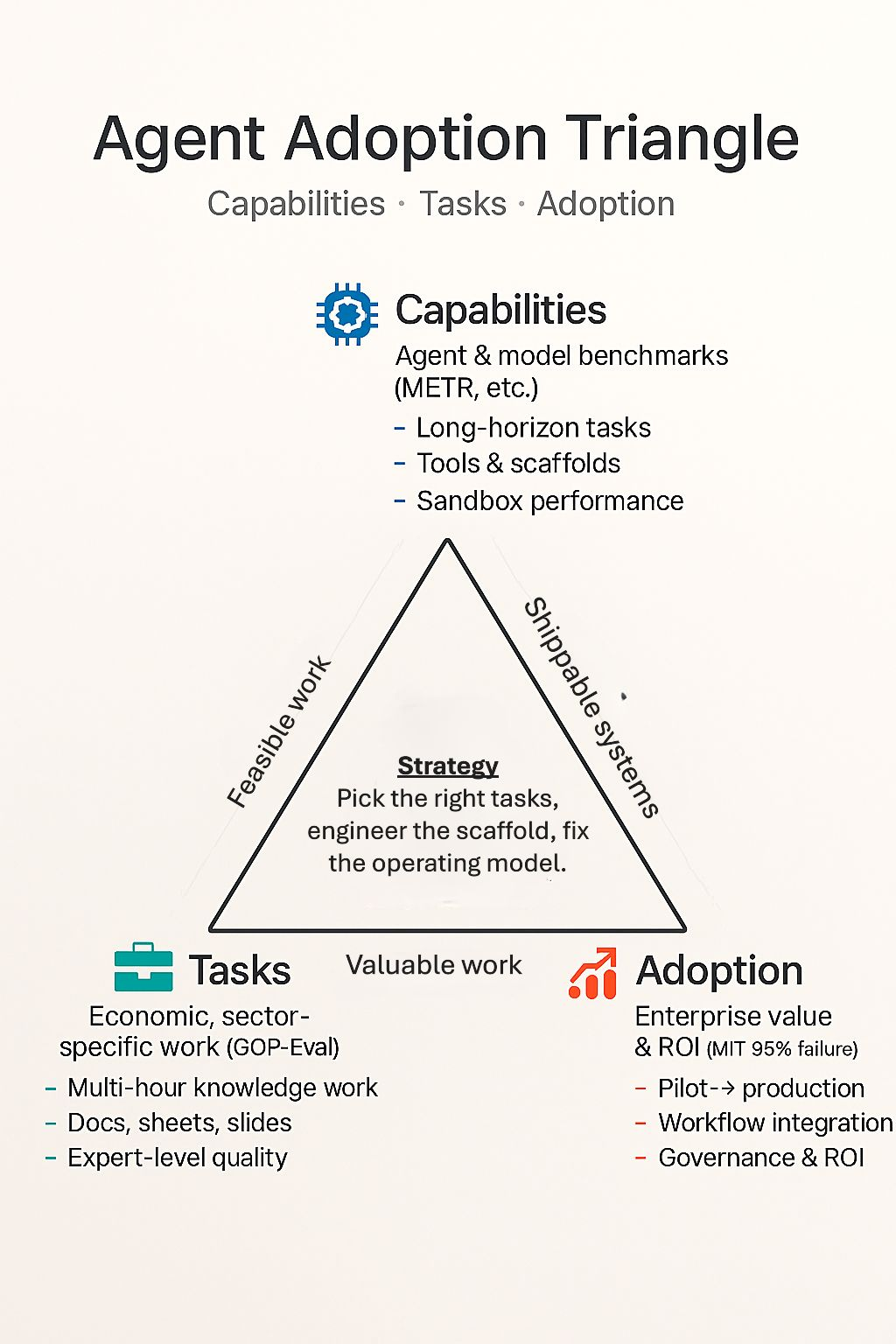
Agent Adoption Triangle, Capabilities, Tasks, Adoption

Visualising Agentic AI as a Triangle, not a straight line

Two of the most-cited studies pull in opposite directions: METR's "agents are doubling in capability" and MIT's "95% of GenAI projects fail." Looking at only one leaves you either overestimating what you can deploy, or underestimating what's possible. The missing lens is the tasks corner, GDP-Eval-style evidence showing how frontier models already perform on the work we actually pay people to do.

Capabilities tell you what's possible. Tasks tell you where value appears first. Adoption tells you how hard it is to ship.

Read on LinkedIn ↗
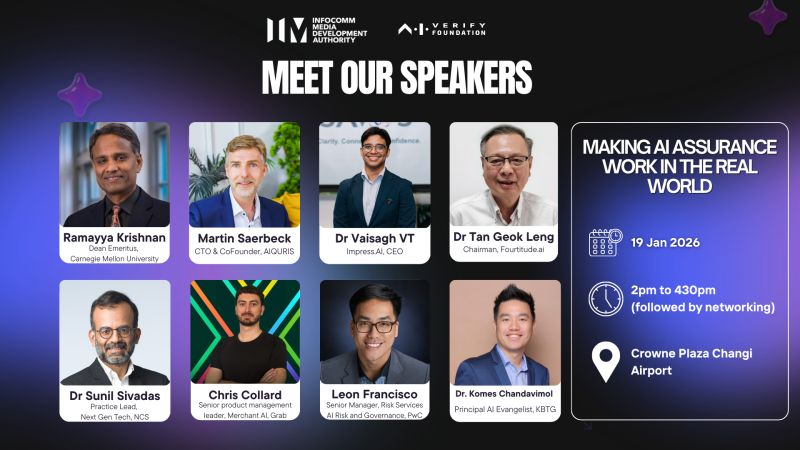
Making AI Assurance Work in the Real World, IMDA speaker card

Making AI Assurance Work in the Real World

With Dr Martin Saerbeck, I demonstrated how to test a multi-turn conversational AI career guidance chatbot, the kind of system where small errors compound across turns and influence high-stakes decisions. Our objectives: discover and characterise risks, define testable assurance requirements aligned to IMDA's Starter Kit three pillars (Hallucination, Undesirable Content, Adversarial Vulnerability), and generate reusable artefacts others can apply.

GenAI systems are probabilistic. They can be helpful and still be wrong, unsafe, or manipulable. Testing is not a checkbox, it is how we earn trust.

Read on LinkedIn ↗
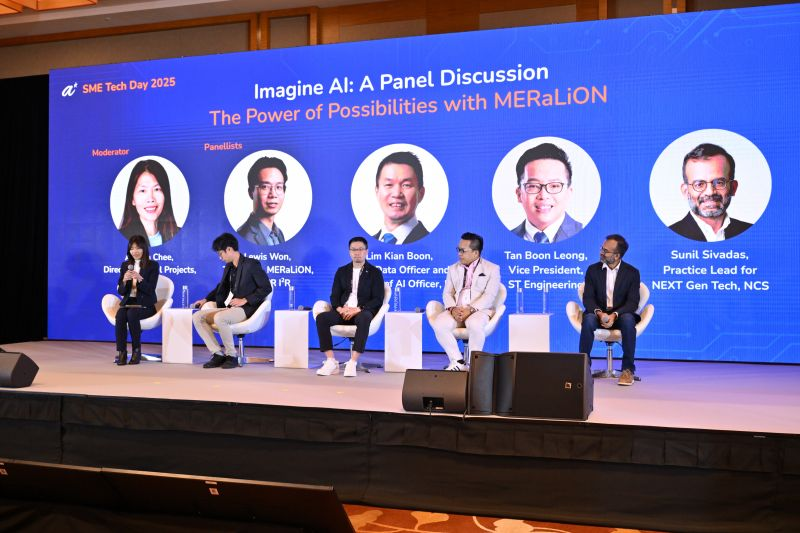
MERaLiON panel at SME Tech Day 2025

The Power of Possibilities with MERaLiON

Panellist at "Imagine AI – The Power of Possibilities with MERaLiON" at SWITCH 2025. MERaLiON is Southeast Asia's empathetic multimodal LLM, designed for the region's diverse languages, cultures, and communication styles. We explored how multimodal LLMs reduce solution complexity, cut response latency, and how hyper-localising AI is the foundation for meaningful adoption and trust, not a side concern.

At NCS, we evaluate MERaLiON not just in isolation but as part of a larger AI stack, integrating with internal workflows, tuning for performance, measuring deployment cost and resilience.

Read on LinkedIn ↗
Sunil Sivadas speaking at AI at Work masterclass

AI is changing tasks before it changes jobs

Most companies are investing in the wrong place. The gap between adoption and impact is the biggest risk. In his Budget 2026 speech, PM Wong announced a National AI Council he'll personally chair and named the real challenge: many firms say they are using AI, but end-to-end transformation requires organising data, rebuilding systems, redesigning processes and jobs, and retraining workers.

That gap, between adoption and impact, is what I addressed in my AI at Work masterclass. 200+ use cases surfaced through NCS Group's SunshineAI hackathons, and a knowledge-sharing culture that turns individual discoveries into organisational learning.

Read on LinkedIn ↗
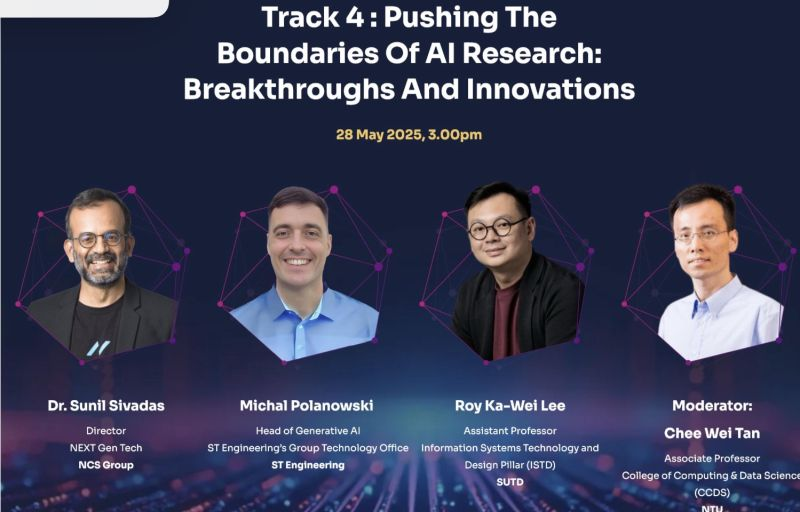
Pushing the Boundaries of AI Research, ATxSummit AISDC

Pushing the Boundaries of AI Research: Breakthroughs and Innovations

Panellist at the ATxSummit AI Student Developer Conference. We explored how learning, teaching, and skill application are transforming to meet an AI-native future, from the ethics of AI in classrooms and vibe coding to how hiring evolves in an AI-first world. In tomorrow's classrooms, AI will be both mentor and brainstorming partner, shifting education from delivering information to orchestrating learning experiences.

Meta-skills, framing problems, critiquing AI output, iterating toward better solutions, age far better than any single tool.

Read on LinkedIn ↗
Recognition

Awards & Teams

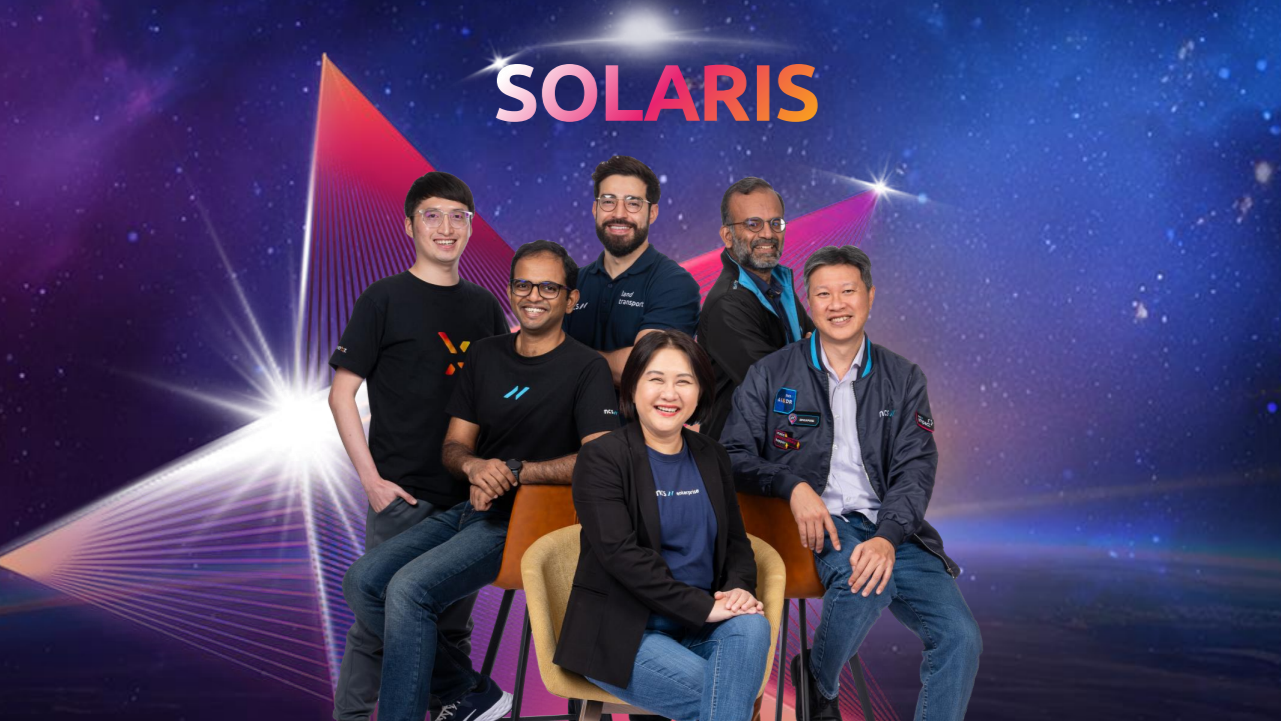
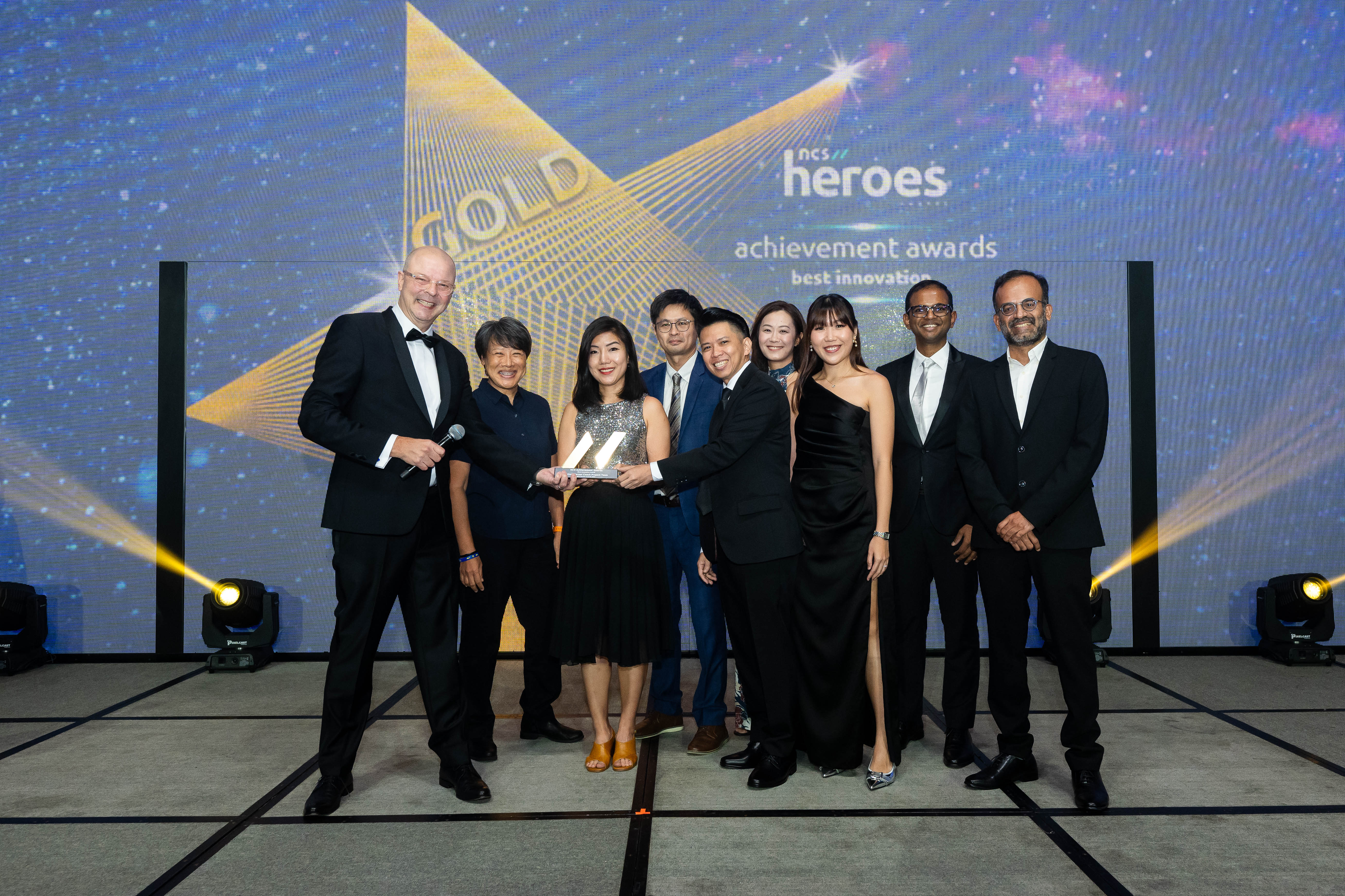
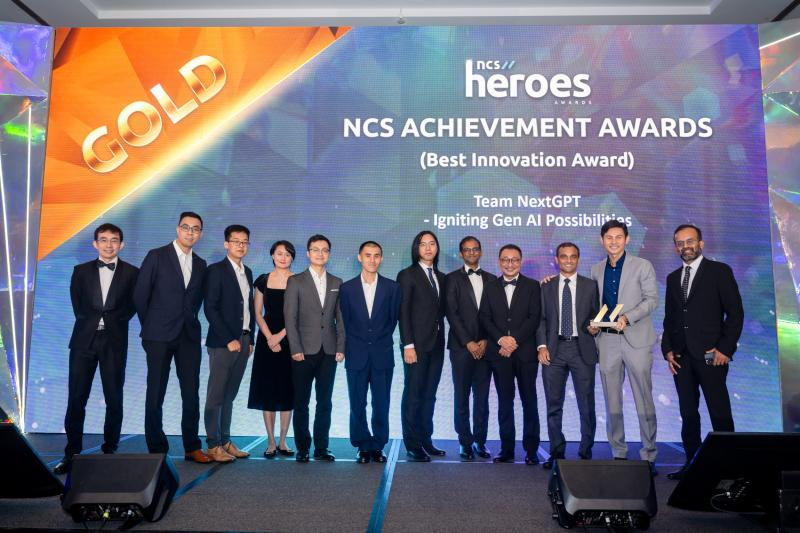
Three consecutive NCS Heroes Gold Awards for Best Innovation, for NEXTgpt (2023), Virtual Career Coach (2024), and SOLARIS Agentic AI (2025).

SOLARIS Project Team, NCS Heroes 2025 Gold
2025
NCS Heroes Gold · Best Innovation
SOLARIS: Agentic AI for Land Transport Operations
NCS Heroes 2024 Gold Award, Virtual Career Coach
2024
NCS Heroes Gold · Best Innovation
Virtual Career Coach Project Team
NCS Heroes 2023 Gold, Team NEXTgpt
2023
NCS Heroes Gold · Best Innovation
Team NEXTgpt: Igniting Gen AI Possibilities
Research

Publications & Patents

1,804
Total Citations
22
h-index
35
i10-index
329
Citations since 2021
Generative AI Computer Vision NLP
2024
An Assessment of an Inpatient Robotic Nurse Assistant: A Mixed-Method Study
Lim YW, Tan SW, Tan CYB, Lee DHM, Siow WT, Heng DGN, Mukhopadhyay A, Lim JC, Sivadas S, Teo ELK, Ho LKY
Journal of Medical Systems, 48(1):99 · 2024
2023
Towards Efficient Video-Based Action Recognition: Context-Aware Memory Attention Network
Thean Chun Koh, Chai Kiat Yeo, Xuan Jing, Sunil Sivadas
SN Applied Sciences, 5(12):330 · 2023
2018
Analysis of Cosine Distance Features for Speaker Verification
George KK, Kumar CS, Sunil Sivadas, Ramachandran KI, Panda A
Pattern Recognition Letters, 112:285–289 · 2018
2005
Pushing the Envelope: Aside [Speech Recognition]
Morgan N, Zhu Q, Stolcke A, Sonmez K, Sivadas S, Shinozaki T, Ostendorf M et al.
IEEE Signal Processing Magazine, 22(5):81–88 · 2005
2024
Multi-Sensor Fusion for Human Action Detection and Human Motion Prediction
Koh TC, Yeo CK, Sivadas S
35th Conference of Open Innovations Association (FRUCT) · IEEE 2024
2022
Recurrent Multi-Head Attention Fusion Network for Combining Audio and Text for Speech Emotion Recognition
Ahn CS, Kasun LLC, Sivadas S, Rajapakse JC
INTERSPEECH, pp. 744–748 · 2022
2016
Discriminatively Trained Joint Speaker and Environment Representations for Adaptation of Deep Neural Network Acoustic Models
Yin M, Sivadas S, Yu K, Ma B
ICASSP 2016, pp. 5065–5069 · IEEE
2015
Investigation of Parametric Rectified Linear Units for Noise Robust Speech Recognition
Sunil Sivadas, Wu Z, Ma B
INTERSPEECH · 2015
2002
Qualcomm-ICSI-OGI Features for ASR
Adami AG, Burget L, Dupont S, Garudadri H, Grezl F, Hermansky H, Sivadas S et al.
INTERSPEECH, pp. 21–24 · 2002  ·  182 citations
2001
Tandem Acoustic Modeling in Large-Vocabulary Recognition
Ellis DPW, Singh R, Sivadas S
IEEE ICASSP Proceedings, Vol. 1 · 2001
2022US 11,457,153
Active Audio-Visual Surveillance System
Chaudhary NK, Sivadas S
Issued September 27, 2022
2019US 10,398,366
Responding to Changes in Emotional Condition of a User
Sivadas S
Issued September 3, 2019
2019US 10,244,988
Method, Apparatus and Computer Program of Using a Bio-Signal Profile
Kangas J, Kärkkäinen L, Nurmi M, Ojanen V, Salminen I, Sivadas S, Vetek A
Issued April 2, 2019
2016US 9,368,018
Controlling a User Alert Based on Detection of Bio-Signals and a Significance Test
Kangas J, Karkkainen L, Nurmi M, Ojanen V, Salminen I, Sivadas S, Vetek A
Issued June 14, 2016
2014US 8,922,376
Controlling a User Alert
Kangas J, Kärkkäinen L, Nurmi M, Ojanen V, Salminen I, Sivadas S, Vetek A
Issued December 30, 2014
2013US 8,487,760
Providing a User Alert
Kangas J, Kärkkäinen L, Nurmi M, Ojanen V, Salminen I, Sivadas S, Vetek A
Issued July 16, 2013
2006US 7,089,178
Multistream Network Feature Processing for a Distributed Speech Recognition System
Garudadri H, Sivadas S, Hermansky H, Morgan NH, Wooters CC, Adami AG, Benitez Ortuzar MC et al.
Issued August 8, 2006
Journey

25 years at the frontier.

Apr 2026–Present
Directs SunshineAI (Agentic AI, Conversational AI, AI Safety) & Principal AI Architect
NCS Group · Singapore
Leading a team of AI engineers to build trustworthy and scalable agentic AI solutions. Actively engaged in shaping the AI safety and security ecosystem. Designing tools and frameworks for AI safety.
Agentic AI Conversational AI AI Safety
Apr 2022–Apr 2026
Director, NEXT Gen Tech
NCS Group · Singapore
Part of NCS's AI strategy and GenAI practice, building from zero to one. Built NEXTgpt, a rapid prototyping sandbox presented to 70+ C-suite clients. Contributing to NCS's large-scale AI adoption initiative. Key innovations include SOLARIS, an agentic AI system for improving the effectiveness of land transport operations.
Agentic AI GenAI Gold Award, NCS Heroes 2023, 2024 & 2025 Google Trailblazers Innovation Award Distinguished Engineer 2022
2021–2023
Deputy Director, Singtel AI Lab (SCALE@NTU)
Nanyang Technological University · Singapore
Developed AI applications for public safety, smart urban infrastructure, transport, and healthcare. Led conversational interface for Florence (robotic nurse assistant trialed at Alexandra Hospital) and traffic management engine for nationwide security robot deployment.
Computer Vision Robotics Healthcare AI
2023–2025
Adjunct Associate Professor, CCDS
Nanyang Technological University · Singapore
Teaching ML operationalization in the wild. Supervising PhD scholars (EDB-IPP) and mentoring undergraduate researchers (URECA).
MLOps PhD Supervision
2018–2021
Associate Director / Lead Research Scientist
NCS · Singtel Cognitive AI Lab @ NTU
Built a lean high-performance research team from scratch. Multi-modal context-aware intelligent systems. Incubated multiple AI-centric products including Ins8.ai, a real-time conversation intelligence platform.
Multimodal AI Conversational AI
2012–2018
Unit Head / Senior Scientist, Human Language Technology
Institute for Infocomm Research (A*STAR) · Singapore
Led conversational AI research. Principal Investigator on public sector and industry projects across Finance, Telco, Healthcare, Security, Transport, and Media. Hired and nurtured a generation of AI researchers.
NLP Spoken Language A*STAR
2004–2012
Senior Researcher
Nokia Bell Labs · Finland
Generated 6 granted patents. Developed noise-robust small-footprint speech recognition for mobile devices. Physiological computing and context-aware systems. Represented Nokia at TC-STAR, the EU Framework Programme for speech-to-speech translation.
6 Patents ASR Physiological Computing
1999–2004
Ph.D., Electrical Engineering
Oregon Health & Science University · Portland, USA
Led technical work for the OGI-ICSI-Qualcomm consortium in ETSI's Aurora Distributed Speech Recognition standardization, one of the best-performing systems. Research on noise-robust front-ends with Prof. Hermansky at ICSI Berkeley and Idiap Switzerland.
Noise-Robust ASR ETSI Aurora 1 Patent